
Maths
Intent: Why we do what we do
At The Meadows Primary School, we believe every child is a mathematician. Our curriculum is coherently sequenced, so pupils build secure knowledge and deep understanding year on year.
Mathematics is an essential life skill. Through a mastery approach, we develop learners who are curious, confident and creative thinkers. We want children to see mathematics as a connected, sense‑making subject that they can explore, enjoy and succeed in.
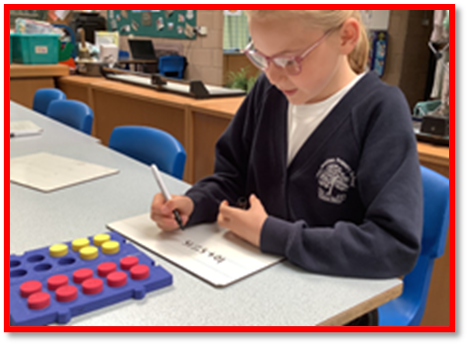
We aim for every child to:
- Secure strong fluency in fundamental mathematical facts and skills.
- Develop deep understanding, not just recall procedures.
- Use precise mathematical language to clearly explain their thinking.
- Reason mathematically by spotting patterns, making connections and justifying ideas.
- Persevere with challenge, recognising that mistakes help them learn.
- Solve problems confidently in a range of contexts across the curriculum and in real life.
- Work independently and collaboratively, supporting one another to succeed.
Teaching at The Meadows is guided by the NCETM’s Five Big Ideas: coherence, representation and structure, mathematical thinking, fluency and variation. These principles ensure all pupils move forward together, supported and challenged appropriately, so that they become secure, confident and capable mathematicians.
Implementation: How we teach maths at The Meadows
At The Meadows Primary School, we follow a Teaching for Mastery approach so that all pupils develop secure, deep and connected understanding. Teaching is carefully sequenced and responsive, enabling pupils to progress together and preventing long‑term gaps through timely intervention.
How we teach mathematics
|
Further details about the five big ideas and lesson planning can be found within the maths policy. |
Our approach is guided by the NCETM Five Big Ideas – coherence, representation and structure, mathematical thinking, fluency and variation. Lessons are planned in small steps, building understanding through the use of manipulatives, images and symbols that expose underlying mathematical structure.
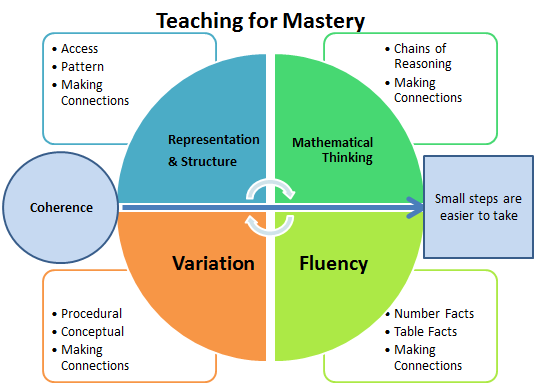
We keep the class working on the same key learning, with scaffolds or depth tasks enabling all pupils to access and master the lesson objective. Challenge comes from deepening understanding, not accelerating through content.
Teachers plan lessons that:
- Use representations purposefully to reveal mathematical structure
- Highlight connections through carefully crafted examples and questions
- Promote reasoning, explanation and precise mathematical language
- Provide structured opportunities to practise, apply and embed knowledge
- Make meaningful links across mathematical domains so learning is transferable (e.g. measures, time, money, statistics)
In EYFS, strong foundations are built through the NCETM Mastering Number programme, which develops secure number relationships and early fluency. Teachers also deliver intentional input for spatial reasoning (shape, position, direction, pattern) aligned to the Early Learning Goals.
Mathematical learning is strengthened through carefully planned continuous provision, with adults modelling precise mathematical language and encouraging children to notice patterns, explore structure and explain their thinking.
Daily mathematics lessons in KS1 and KS2 (45–60 minutes) include direct teaching, guided practice and independent application. Pupils also take part in a daily fluency session (10–20 minutes) to develop fluency in key facts and relationships, supporting efficient calculation and secure recall.
When needed, pupils receive pre‑teaching, same‑day intervention, or additional depth tasks so all children can keep pace with the learning sequence.
What this looks like in classrooms
You will see:
- Pupils using manipulatives, images and symbols to make sense of mathematical structure
- Examples and questions that draw out patterns and connections
- All pupils engaged in the same learning, supported or challenged as needed
- Working walls, stem sentences and models that reinforce precise mathematical vocabulary
You will hear:
- Pupils reasoning mathematically: “I know this because…”, “It’s the same as…”, “I noticed…”
- Teachers probing thinking with purposeful, carefully chosen questions
- Confident mathematical talk, collaboration and curiosity
You will feel:
- A calm, purposeful atmosphere where everyone believes “We can all do maths.”
- Pupils showing pride, perseverance and enjoyment in tackling challenges
- A shared understanding that mathematics is a journey towards depth and secure understanding for every child
Impact: How we will know if we have been successful
Our mastery curriculum enables pupils to think and talk mathematically with confidence, supported by classrooms where representations, structure and precise language secure deep understanding. Pupils approach challenge with resilience and a positive attitude, seeing mathematics as meaningful and relevant.
As a result, pupils demonstrate:
- fluency, confidence and deep understanding
- confident reasoning and accurate mathematical vocabulary
- successful problem solving in varied contexts
- positive attitudes, perseverance and enjoyment of mathematics
- secure readiness for the next stage of learning and future study
How can you help your child at home?
1. Be positive about maths. Try not to say things like "I can't do maths" or "I hated maths at school" – your child may start to think like that themselves.
2. Point out the maths in everyday life. Include your child in activities involving numbers and measuring, such as shopping, cooking and travelling.
3. Praise your child for effort rather than for being "clever". This shows them that by working hard, they can always improve.
4. Support your child to complete their weekly maths homework set by the class teacher.
Here are some website suggestions to support children with their maths at home.
Timestables Rock Stars Home - Times Tables Rock Stars (KS2)
Numbots NumBots | Motivational maths practice for schools and families. (KS1)
These sites are great to simulate the Multiplication tables check that children will take in year 4.
https://mathsframe.co.uk/en/resources/resource/477/Multiplication-Tables-Check
https://www.timestables.co.uk/multiplication-tables-check/
Oxford Owl offer a range of games, activities and videos to support maths at home.
https://home.oxfordowl.co.uk/kids-activities/fun-maths-games-and-activities/
https://home.oxfordowl.co.uk/?s=times+tables&fwp_post_types=activities
https://home.oxfordowl.co.uk/maths/
Maths games
KS1 https://thirdspacelearning.com/blog/maths-games-ks1/
KS2 https://thirdspacelearning.com/blog/maths-games-ks2/
Mathsframe: a range of interactive games for different areas of maths.
https://mathsframe.co.uk/en/resources/category/22/most-popular
Here are just a few ideas, but a quick google search e.g. maths games for Key stage 1 or 2 will uncover many more:
- Top Marks A very useful website with a variety of maths games to support learning across all areas.
- Mental Maths Train A useful maths game to support arithmetic skills
- Hit the Button A useful maths game to support arithmetic skills
- Daily 10 A useful maths game to support arithmetic skills. Children can choose their own level of challenge and the area of questions to focus on.
- Tell the time cat Click on control panel to tell the time.
- Maths Game - Dinosaur Dentist Use near doubles to add quickly in your heads
- Robin Hood Doubles to 10 Doubling to 10
- Castle Catapult Adding to the next multiple of 10 (10s number)
- Space Jumps Addition Adding in your heading
- Save the Whale Number bonds to 10
- Funky Mummy Adding - totals less than 20
- Shark Numbers 1 A place value game - what number is shown from Base 10?
- Free online Maths games Lots here to choose from.
What do children at The Meadows think about Maths?
“Maths is good we get to learn more maths like work with the rekenreks. Mrs Thomas says which number we have to make and then we make the number.” (Chicks)
“I like to do Number Blocks and Rekenreks.” (Duckings)
“Maths is good. I like putting my hand up to answer questions and getting picked with the lolly pop sticks.” (Wrens)
“Maths is good. We do a lot of counting and talking with our partners.” (Wrens)
“Maths is nice to get to learn new things that you didn’t know before.” (Robins)
“Maths is really fun I get to learn new things to make me smarter” (Owls)
“I think maths is interesting because I learn new ways of adding, subtracting and multiplying.” (Owls)
“I like maths you get to figure out the answer and keep it in the back of your brain until you need it next time.” (Puffins)
“I like how you get to use different equipment to help you in Maths” (Puffins)
“Maths is like a sport it helps you learn how to count and do times tables” (Puffins)
“Sometimes if I struggle I ask the teacher and then do some practise at home” (Kingfishers)
“I like Maths I like adding and it’s fun to learn” (Kestrels)
“I like it because I don’t usually get stuck but if I do I can talk to my partner.” (Kestrels)
Hawks
“I think it’s a nice subject because equations help it make sense and the methods we are taught help me.” (Hawks)
“I like maths because lots of different topics help us to solve everyday problems and figure out the solution.” (Hawks)
“I like maths if you want to be a teacher it will help you to teach the children maths and how to solve equations.” (Hawks)
“I like to learn maths you get to learn new stuff and know things you didn’t know before which is fun.” (Year 6)
“I like Maths because the teacher makes it fun and we get to learn new things.” (Year 6)
“I like arithmetic. You get to see if you make a mistake and you can learn from it.” (Year 6)